
New Tech Brings Better Kill on Zombie Weeds
Post-Harvest Burndown Boost
“Satchur 8® has a very large benefit for the few dollars an acre it costs because we don’t have to go back to that field again and try to do a cleanup job.”
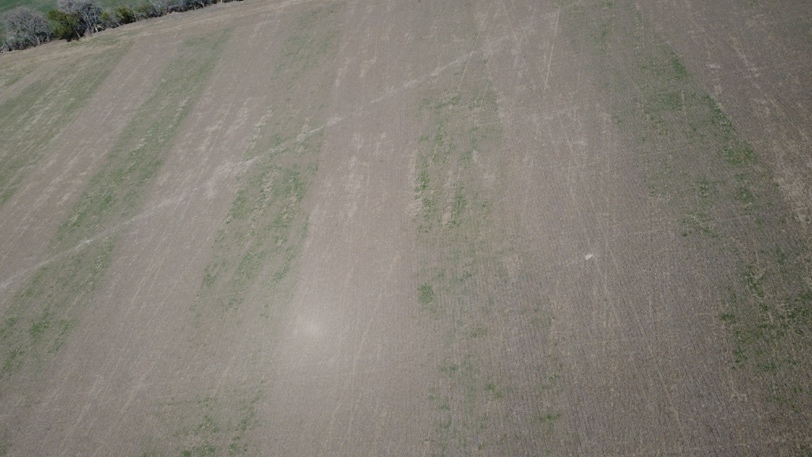
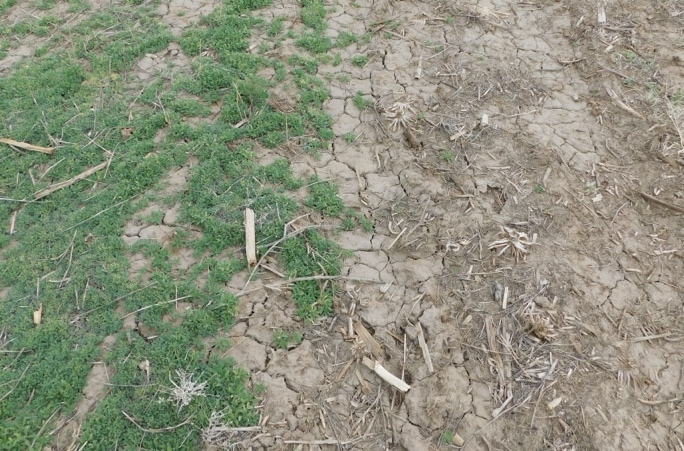
Kill Zone. Aerial photo (left) of 90-foot swaths comparing flumioxazin and Satchur 8® (bare stripes) versus untreated. Weed pressure (right) at ground level. Photos taken in April following a November application.
Imperial, Neb., Sept. 10, 2026 – It’s like those zombie movies, but for farmers in the Great Plains, it might be even scarier. In this case, the zombies reproduce fast and swarm unless you get complete kill the first time.
“With Palmer amaranth, one plant, outside of competition, can put on more than a million seeds,” explains Jeff Wessels, research agronomist at Frenchman Valley Coop, Imperial, Neb. “Even when it’s competing with a crop, it can still put on hundreds of thousands of seeds.” WATCH VIDEO
For Wessels, fighting and killing zombie weeds like Palmer and kochia has been a lifelong work of trial-and-error research of chemistry, adjuvants and application timing. And he says he’s recently found a new tool that’s increasing the efficacy of every trip across the field. It comes to agriculture from the healthcare industry, and it’s called Satchur 8®.
“SATCHUR 8 helps spread out the chemistry and gets it into the weed leaf better,” says Wessels. “We have a lot of Palmer amaranth and kochia, so we have a lot of broadleaf weeds in our wheat stubble. We need a solid control with a fall burndown to stay ahead of this weed pressure and SATCHUR 8 in the tank is bringing us a much better kill.”
Making the most of the fall application is the unique bonding nature of SATCHUR 8 that holds the chemistry in the top of the soil to avoid any leaching, thereby making the chemistry more effective and longer-lasting.
“We can go out there and spray and we get a much better jump on the weeds the next year,” he says. “We don't spray until the soil temps get down to 50 degrees – roughly around the first of November – so that the soil microbial activity slows down so those herbicides will last well into the next year. SATCHUR 8 has a very large benefit for the few dollars an acre it costs because we never have to go back to that field again and try to do a cleanup job.”
Originally developed as an aid for fighting cancer in human healthcare, the SATCHUR 8 formulation has the exceptional characteristic of keeping active ingredients in place to increase their efficacy. In the case of fighting cancer, it assisted in holding chemotherapy agents at the site of the malignancy. For herbicides, fungicides and insecticides needing contact to do their work, this unique property means keeping the chemistry in the right place over time.
“The power of SATCHUR8 is in its trillions of little microfibers that stick to the leaf service like Velcro when applied and hold the herbicide it’s mixed with on the leaf surface,” explains Larry Fiene, founder and CEO of Planet Earth Agronomy, Mt. Horeb, Wisc., the company that formulated and rigorously tested the technology for use in agriculture. “It won't wash off and won't dry up and blow off the surface. Residual weed control is lasting longer because the active ingredient is being retained in the soil upper profile longer.”
Research Wessels has conducted for Frenchman Valley Coop over the past several years also points up benefits to the fall season application of Carbon Cycle®, a biological product that applies a consortium of microbes through the fall spray pass to improve the soil and seedbed for the next crop.
“CARBON CYCLE has several benefits as a residue management tool,” says Wessels. “We want nice seed to soil contact, and nice even planting. Another benefit is getting those nutrients to release from the residue and into the soil.” Wessels has studied the impact of CARBON CYCLE across several years and has found multiple benefits to its use on several crops.
“Several years ago, I put CARBON CYCLE out where manure had been applied under irrigation,” he relates. “When I sampled the soil again to see about the manure residue breakdown, I found we got a 27% higher phosphorus release from the CARBON CYCLE, and almost a 40% higher potassium release.” Wessels says that he’s seen enough over the years to recommend CARBON CYCLE every season.
“When you can apply less fertilizer, get better planting conditions and get nutrients released out of the soil, it's clearly a win,” he smiles.
About Frenchman Valley Coop
Frenchman Valley Coop (https://www.fvcoop.com) is a leading agricultural cooperative serving Kansas, Nebraska, Colorado, and Wyoming. Our values of integrity, innovation, and dedication guide us in every endeavor – ensuring that we not only meet but exceed the needs and expectations of our patrons. From offering the best in agronomy, feed, energy, and grain services to fostering sustainable farming practices, our focus remains steadfast: to contribute significantly to the success of our members and the wider agricultural community.
About Planet Earth Agronomy
Planet Earth Agronomy (www.planetearthagronomy.com) is an agronomic consulting and new product development business providing quality products, outstanding insight, and best-in-class service to farm businesses seeking to produce higher yields and greater return on investment while safeguarding their land for future generations. With research farms, offices and warehouses in Wisconsin and Nebraska, Planet Earth Agronomy is devoted to bringing proven innovative technology to growers seeking to earn more from every acre they farm. For more information, visit www.planetearthagronomy.com.